Community Event Listings

Tafelmusik: Influencers: The Bachs, Mozart & Haydn - Apr. 10-12

Move over Instagram!

For the original influencers, look no further than the Bach family.
Sons of the great J.S. Bach, Johann Christian and Carl Philipp Emanuel wrote music in a style that bridged the baroque and classical periods. Using musical idioms that favoured melody, drama and elegance, they paved the way for classical icons like Mozart and Haydn.

Directed from the violin by Principal Guest Director Rachel Podger, our program traces the synergies among these composers, whose mutual admiration was well known. In fact, J.C. Bach was like a father figure to Mozart, who played keyboard duets with him as a child.

CPE Bach’s mercurial Cello Concerto in A Major features Tafelmusik’s own “ravishing” (Concerto.netKeiran Campbell as soloist in a showcase that alternates lyricism with virtuosity. Meanwhile, Podger continues her exploration of Mozart’s violin concertos with Tafelmusik, this time turning her attention to the Concerto no. 3 and displaying her “astoundingly mature” affinity (Musicweb International) for the composer’s music.   

Opening with J.C. Bach’s dramatic Sinfonia in G Minor, our matrix of classical influencers concludes with the “razor sharp” and “sensational” combination (Early Music America) of Podger leading Tafelmusik in Haydn’s intense Symphony no. 52. 

April 10, 8:00 pm
April 11, 8:00 pm
April 12, 3:00 pm

Tickets & Info: Influencers – Tafelmusik : Tafelmusik

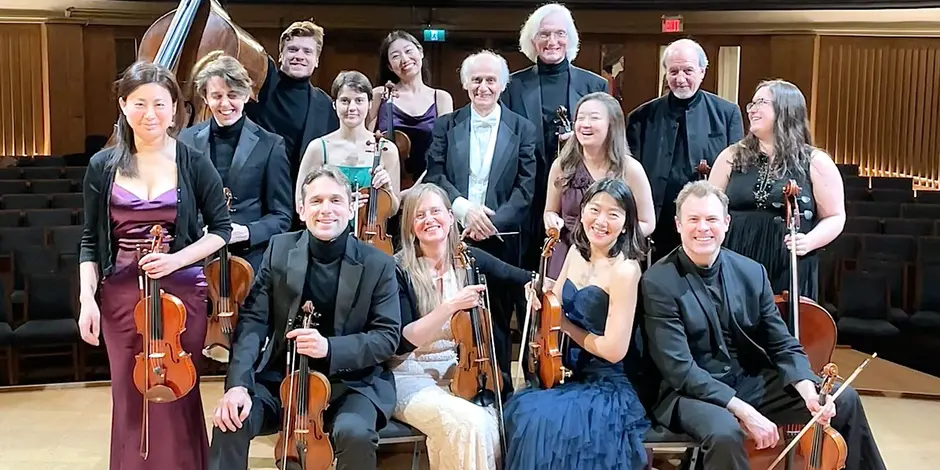
Amici Chamber Ensemble - Roll Over Beethoven: From the Beatles Fab Four to the Maestro - Apr. 19

Get ready for an unforgettable afternoon of music united by a shared commitment to innovation and artistic expression! Join us for an extraordinary concert featuring the iconic sounds of The Beatles and the timeless compositions of Beethoven. Experience the magic of The Fab Four’s revolutionary rock hits, reimagined alongside the majestic power of Beethoven’s masterpieces. Whether you’re a fan of the classic harmonies of the Beatles or the dramatic brilliance of Beethoven, this concert brings together two musical worlds in a stunning fusion that will captivate your senses. Don’t miss out on this one-of-a-kind event that celebrates the genius of these legendary artists – where past and present collide in perfect harmony. Featuring guest artists James Daly, Jonathan Crow, Steven Dann, Joel Quarrington, Marlène Ngalissamy, Neil Deland, Graham Lumsden and Domenik McDonald.

Sun. Apr. 19, 3:00 PM

Tickets & Info: ROLL OVER BEETHOVEN – 2026 – Amici Chamber Ensemble

Earth Week Retreat: Rooted in Earth, Rising in Creativity! - Apr. 25

Join us for this day-long Earth week retreat. Come explore your connection to the earth, nurture your creativity and be inspired!

Join Trinity St. Paul’s United Church community as we explore our relationship with the Earth, honour our feelings about the climate crisis, nurture and renew our spirits, and get inspired for healing work in the world. The day will feature Work that Reconnects practices, singing in community, creative arts workshops, and a workshop about sabbath as gift.

Sat. Apr. 25, 9:15 AM

Tickets & Info: Earth Week Retreat: Rooted in Earth, Rising in Creativity! Tickets, Saturday, Apr 25 from 9:15 am to 4 pm | Eventbrite

Tafelmusik: Hearing Her Voice - Apr. 30 - May 3

In her eagerly anticipated return to Tafelmusik, the “jaw-dropping” (Boston Classical Review) soprano Amanda Forsythe gives voice to dramatic and brilliant music by women.

Grammy award-winning soprano Amanda Forsythe returns to Tafelmusik to bring to life striking music by unjustly forgotten women composers. Discover brilliant works by Elisabeth Jacquet de la Guerre, Barbara Strozzi, Mademoiselle Duval, Wilhelmine von Bayreuth, Maria Teresa Agnesi, Maria Margherita Grimani, and the enigmatic Mrs Philarmonica. Premiering a newly commissioned work by Métis composer Karen Sunabacka, this program celebrates dramatic and sublime music by women.

Our celebration of female perspective and talent extends into the 21st century with a newly commissioned work by Métis composer Karen Sunabacka, set to text by her mother, the Métis writer Joyce Clouston. Known for her powerfully evocative music, “Sunabacka creates a brilliant sense of space” and “displays an incredibly in-depth knowledge of instrumental technique” (I Care if you Listen).

April 30, 7:30 pm
May 1, 8:00 pm
May 2, 8:00 pm
May 3, 3:00 pm

Tickets & Info: Hearing Her Voice – Tafelmusik : Tafelmusik

Annual Spring Church Fundraiser - Spirit of the Annex - May 22

Join us for our annual spring Church fundraiser, Spirit of the Annex!

Community | Silent & Live Auctions |
Human Library | Mocktails | Trivial Pursuit | Fun and Fellowship!

Friday May 22

7:00 PM

Arkel Chamber Concerts - Grand Romance - May 31

Complete Tour de Force- four, then six, then Eight strings in an ecstatic journey from the classical to complete Romantic rapture!

Joseph Haydn- String Quartet Op. 33 No. 1
The Op. 33 string quartets, of which there are six, are often dubbed the “Russian” quartets, because they are dedicated to the Grand Duke Paul of Russia. No. 1 is the only one in a minor key and exhibits the freedom of form that Haydn had already adopted in his Op. 20 set. The ten-year gap between the two sets were spent directing the music for 50 operas at the Esterhazy palace in Vienna, 5 of which were his own compositions; there was also a young Italian singer named Luigia Polzelli who may have served as a distraction! In any case, Haydn announced the Op. 33 quartets as “written in a new and special way, for I have not composed any for ten years”, and they are considered to be works of yet more masterful confidence.

Richard Strauss- String Sextet from Cappriccio
The string septet is from Strauss’s last work for the stage, the opera Cappricio, composed in 1942. The opera takes the form of a series of elegant salon conversations that explore the question of what is more important, the words or the music to an opera. The septet begins the opera as both a prelude to the action and as the first topic of conversation, and is written in the late Romantic style of the 1880s and 1890s.

George Enescu- Octet for Strings in C Major, Op. 7
Enescu wrote his Octet for strings in C major, Op. 7, over a span of a year and a half, completing it in 1900. He wrote of the challenge of its huge form, “I wore myself out trying to work a piece of music divided into four segments of such length that each of them was likely at any moment to break. An engineer launching his first suspension bridge over a river, could not feel more anxiety than I felt when I set out to darken my paper.”

The Octet is considered one of the few works that is a worthy successor to Mendelssohn’s celebrated Octet Op. 20.

May 31, 3:00 pm

Tickets & Info: GRAND ROMANCE Tickets, Sunday, May 31 at 3 pm | Eventbrite